
Patios
Porcelain and Indian sandstone patios in Southport
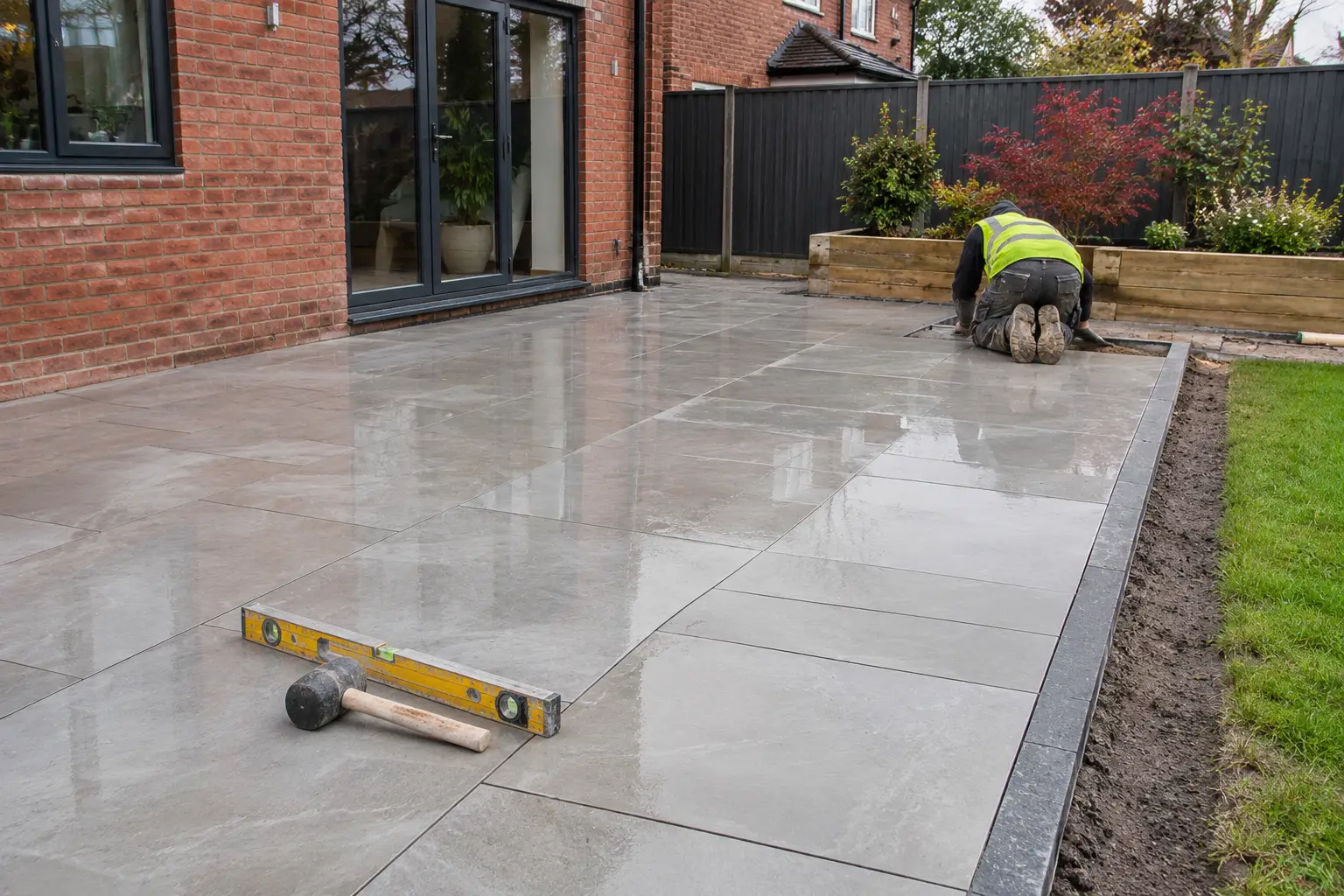
Patios laid on a properly dug out, compacted base, every slab on a full bed of mortar, falling gently away from the house so the rain runs off. Porcelain primed so it never works loose.
Which paving?
We lay porcelain, Indian sandstone, limestone and slate, in a range of colours and slab sizes. We also build steps and raised patios for sloping gardens.
Porcelain
Man made slabs that look like stone, slate or wood. They do not soak anything up, so no stains, no sealing and very little moss. Hard to cut and they must be laid on a full bed with a primer, so they cost more to lay than natural stone.
Indian sandstone
Natural stone, every slab a little different, with a riven (rough, split) or sawn smooth face. Warm colours and good grip. It soaks up water, so it can mark and go green in shade, and a sealer helps.
Limestone
Natural stone with a smooth, even look, usually in soft greys and blues. Smarter and more uniform than sandstone, and it suits modern houses.
Slate
Dark natural stone in greys, blues, greens and purples, in a choice of slab sizes. Hard wearing with a fine texture that looks good wet or dry.
The two things that ruin a patio
Water going the wrong way. A patio that is flat or falls towards the house puts rain against your wall and under your doors. Ours fall gently away and stay below the damp course.
Slabs on dabs. Five blobs of mortar under each slab leaves gaps for water to sit and freeze. Slabs rock, crack and come loose. We lay every slab on a full bed.
How we lay a patio
- 1
Look and measure
Levels, the height of the damp course, where the rain will go. Then a written quote.
- 2
Dig out
Down to firm ground. The spoil goes on our grab lorries.
- 3
Sub-base
Type 1 (crushed stone) compacted in layers, set to a slight fall away from the house.
- 4
Edging and drainage
Edging set in concrete, plus a channel drain at the doors if the patio meets them level.
- 5
Lay the slabs
Each slab on a full bed of mortar. Porcelain gets a primer painted on the back first so it bonds.
- 6
Point the joints
Joints filled with a pointing mortar or jointing compound so weeds and water stay out.
Questions people ask
Porcelain or Indian sandstone?
Porcelain if you want something that stays clean and looks the same in ten years with almost no upkeep. Indian sandstone if you want natural stone with a softer, older look and do not mind a clean and seal now and then. Porcelain usually costs more.
Why do porcelain slabs come loose?
Because porcelain does not soak anything up, plain mortar will not grip it. It needs a primer on the back of every slab and a full bed of mortar underneath, not five dabs. Skipping either is the most common reason porcelain patios fail.
How high can a patio be next to the house?
It must stay below the damp proof course, the waterproof layer near the bottom of your wall, usually about two bricks below it. Higher than that and water can get into the wall. Where a patio meets doors level, a channel drain takes the water away.
Do I need planning permission for a patio?
Not usually for a back garden patio at ground level. A raised patio or decking more than 30 cm off the ground can need it, and listed buildings and conservation areas have their own rules.
Can you build a patio on a sloping garden?
Yes. We build raised patios with retaining edges and steps down to the lawn, or dig the slope back to make a level area. We will tell you which works best for your garden.
Is porcelain slippery?
Outdoor porcelain has a textured, slip rated surface and is grippy in the wet. Indoor tiles are not, so make sure the slabs are made for outside.
What affects the price?
The slabs you choose, the size, how much has to be dug out, steps or changes in level, drainage and access. We give you a written quote after looking at the job.
Also worth a look
Send us a photo of your garden
Phone lines open Monday to Friday 8am to 5pm, Saturday 8am to 1pm. WhatsApp photos of the job any time, we reply in office hours.