
Off-grid drainage
Septic tanks and treatment plants
For homes, farms and businesses that are not on the mains sewer. We install, replace and repair septic tanks, fit sewage treatment plants, test the ground and build drainage fields, and make sure it all meets the Environment Agency's rules.
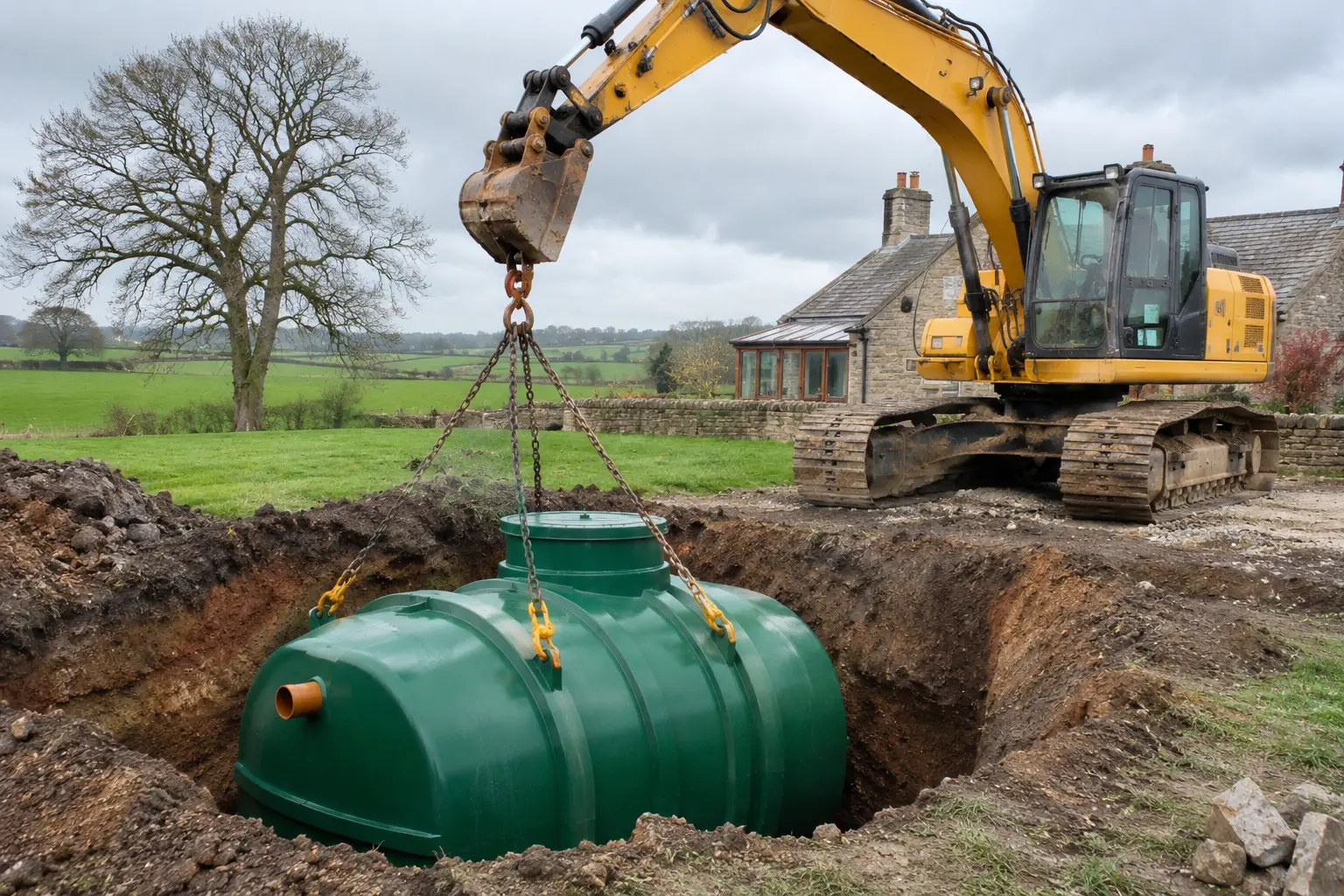
What we do
Each of these has its own page with more detail.
Septic tank installation and replacement
New septic tanks, old ones replaced, and repairs to tanks and drainage fields.
Sewage treatment plants
Klargester, Marsh and other makes installed. Cleaner water out, so it can go to a ditch or stream within the rules.
Soakaways and percolation tests
Testing how fast your ground drains, the first step in designing any drainage field.
Drainage, CCTV surveys and repairs
The pipes from the house to the tank, surveyed with a camera and repaired or relaid.
Septic tank, treatment plant or cesspit?
The three kinds of off-mains system, and the difference that matters most: where the water goes.
| System | What it does | Where the water goes | Needs power | Upkeep |
|---|---|---|---|---|
| Septic tank | Settles the solids. The liquid is only partly treated | A drainage field in the ground only. Never a ditch or stream | No | Emptied at least once a year |
| Sewage treatment plant | Treats the waste with air and bacteria, so the water is much cleaner | A drainage field, or a ditch or stream that flows all year | Yes | Emptied and serviced as the maker says |
| Cesspit (cesspool) | Holds everything. No treatment | Nowhere. It is a sealed tank | No | Emptied often, sometimes every few weeks |
The general binding rules, in plain English
In England, small sewage systems have to follow the Environment Agency's general binding rules. Meet them and you do not need a permit. The main ones:
- Domestic sewage only: toilets, bathrooms, kitchens
- No more than 2,000 litres a day to the ground, or 5,000 litres a day to a stream or ditch
- A septic tank can only discharge to a drainage field in the ground. Only a treatment plant can discharge to a watercourse
- Built to the British Standards and sized to British Water's Flows and Loads guidance
- Emptied at least once a year, or as the maker says, by a registered waste carrier
- Kept in good working order, and repaired or replaced if it is not
- Tell the buyer in writing when you sell the house
Septic tank going into a ditch?
A septic tank that discharges straight into a ditch, stream or river breaks the rules. It has to be dealt with as soon as possible, and it nearly always comes up when the house is sold.
The usual fixes are a new drainage field so the tank discharges to the ground, or swapping the tank for a sewage treatment plant. We test the ground and tell you which suits your site.
Check your system against the rulesWhat size treatment plant do you need?
How an off-grid drainage job works
- 1
Survey
We find the tank, lift the lids, trace where it discharges and check the pipes with a CCTV camera.
- 2
Test the ground
A percolation test shows whether a drainage field will work and how big it needs to be.
- 3
Choose the system
Septic tank and drainage field, or a treatment plant, sized for the house and checked against the rules.
- 4
Written quote
The tank, the digging, the drainage field or outlet, and putting the garden back.
- 5
Install
Dug in with our own machines, connected, tested, and the old tank emptied and taken out or filled in.
Questions people ask
What does off-grid or off-mains drainage mean?
Your house is not connected to the public sewer, so the waste goes into your own tank on your land: a septic tank, a sewage treatment plant or a cesspit. Many farms, cottages and village homes around Southport and West Lancashire are like this.
Is my septic tank legal?
In England, a septic tank must not discharge straight into a ditch, stream or river. If yours does, the rules say it must be dealt with as soon as possible: replaced with a treatment plant, given a drainage field, or connected to the sewer. If it goes to a drainage field in the ground and is looked after, it is usually fine. We can survey it and tell you.
What are the general binding rules?
The Environment Agency's rules for small sewage systems in England. In short: domestic sewage only, no more than 2,000 litres a day to the ground or 5,000 litres a day to a stream, the right system for where it discharges, built to the British Standards, emptied at least once a year by a registered waste carrier, and kept in good working order. If you can meet them, you do not need a permit.
I am selling my house. What do I need to do?
You must tell the buyer in writing that the house has its own sewage system, with its details, where it is and its maintenance records. If a septic tank discharges straight to a watercourse, you and the buyer must agree who will replace or upgrade it as a condition of the sale. Buyers' solicitors ask about this, so it is worth sorting before you sell.
Can I connect to the mains sewer instead?
Sometimes. For a new system, if a public foul sewer is within 30 metres of your boundary, the rules expect you to connect to it. Connecting needs the water company's permission. We can dig and lay the connection.
Do you empty septic tanks?
No. We install, replace and repair septic tanks and treatment plants. Emptying is done by a registered waste carrier with a tanker.
Do I need permission for a new system?
A new septic tank or treatment plant needs building regulations approval, and sometimes planning permission. If your system cannot meet the general binding rules, you need an environmental permit from the Environment Agency.
Tell us about your septic tank
Phone lines open Monday to Friday 8am to 5pm, Saturday 8am to 1pm. WhatsApp photos of the job any time, we reply in office hours.