
Off-grid drainage
Septic tank installation and replacement
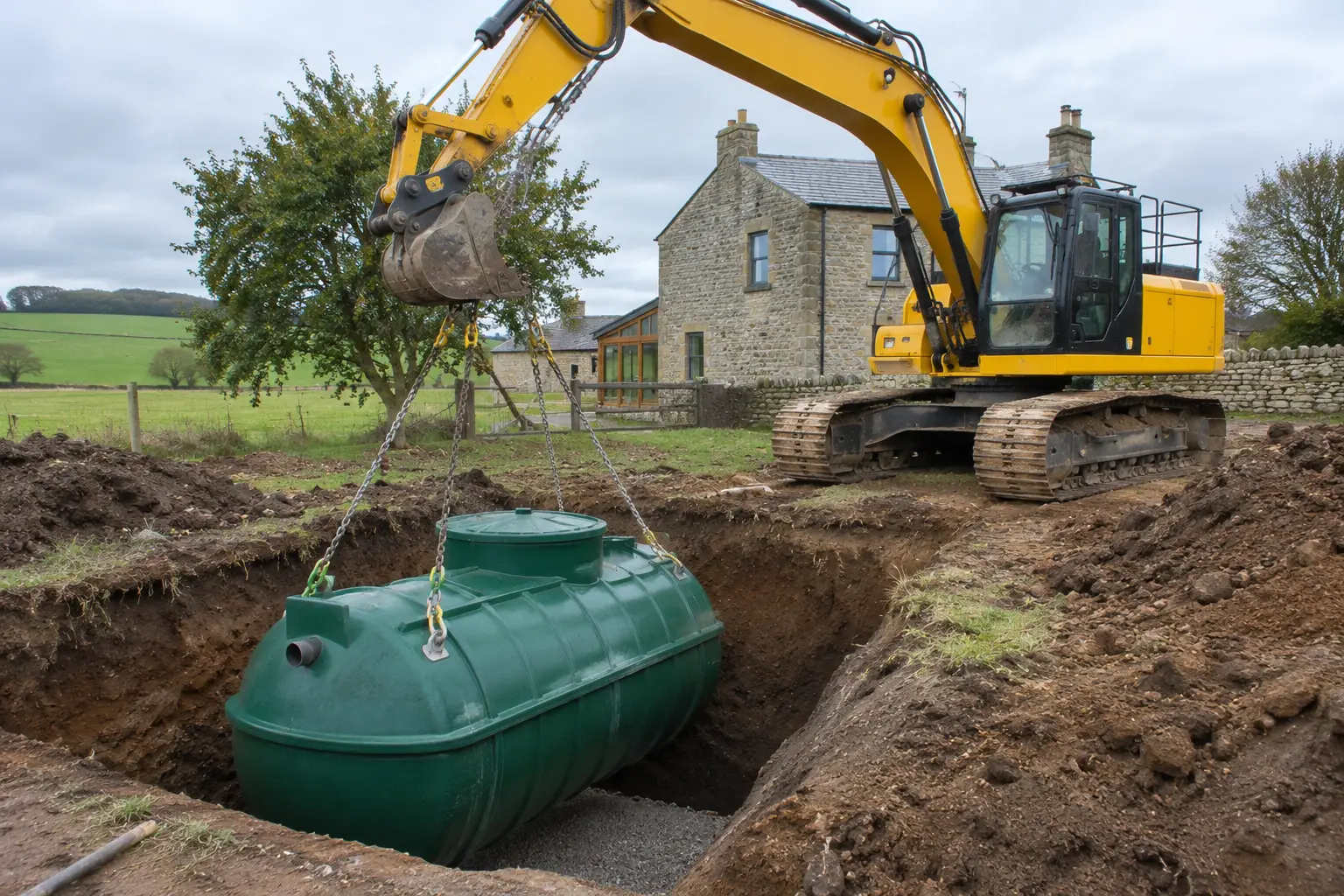
New septic tanks, old ones replaced, and repairs to tanks and drainage fields. We test the ground, design the drainage field, and dig it all in with our own machines, to the Environment Agency's rules.
What we do
New septic tanks
For a house, barn conversion or holiday let that is not on the mains sewer. Tank and drainage field sized for the property, dug in and connected.
Septic tank replacement
Old brick and concrete tanks crack and leak, and some still discharge into a ditch. We take the old one out or fill it in, and put in a new tank or a treatment plant.
Repairs
Broken pipes in and out, cracked lids and chambers, dip pipes (the T-shaped pipes inside that hold back the scum) that have fallen off, and blocked or failed drainage fields.
Drainage fields
The pipes that spread the water from the tank through the ground. Designed from a percolation test, and replaced when the old one has clogged.
Signs your septic tank is failing
- Toilets and sinks draining slowly, or gurgling
- A sewage smell around the tank or over the drainage field
- Soggy, very green or sunken grass over the drainage field
- The tank filling up much faster than it used to after emptying
- Water backing up into the house when it rains
Often the tank is fine and it is the drainage field that has clogged after years of use. A survey and a camera down the pipes tells us which.
Is your tank breaking the rules?
If your septic tank discharges straight into a ditch, stream or river, it does not meet the general binding rules. It has to be put right as soon as possible, and buyers' solicitors will ask about it when you sell.
The fix is either a drainage field, so the tank discharges into the ground, or a sewage treatment plant. A percolation test tells us which will work.
Check your system against the rulesDoes your septic tank meet the rules?
Answer a few questions to check your system against the Environment Agency's general binding rules for England. If you do not know an answer, pick "Not sure" and we will tell you what to check.
Answer the questions and press Check my system.
Where the rules come from
The general binding rules on GOV.UK, for small sewage discharges to the ground and to surface water. Under 2 m³ a day to the ground, or 5 m³ a day to a watercourse, and meeting every rule, you do not need a permit.
Daily volume uses the Environment Agency's own calculator: 2 people per house plus 1 per bedroom, at least 5, and 150 litres a person a day.
Not covered here: protected wildlife sites (SSSIs, special areas of conservation and similar) and the newer rules on sharing an outlet. We check those when we survey.
This is a guide, not legal advice.
How we install a septic tank
- 1
Survey
We find the tank, lift the lids, check where it discharges and look at the pipes with a CCTV camera.
- 2
Percolation test
Holes dug where the drainage field will go and timed as they drain, to the British Standard (BS 6297).
- 3
Design
Tank and drainage field sized for the house, positioned the right distances from the house, water supplies and watercourses.
- 4
Dig and install
With our own machines. Tank bedded and backfilled, drainage field trenches laid with perforated pipe in stone.
- 5
Make good
Old tank emptied and removed or filled in, ground reinstated, and the records you need to keep.
Questions people ask
How does a septic tank work?
Waste from the house flows into the tank. Solids sink to the bottom as sludge, grease floats to the top as scum, and the liquid in the middle flows out to a drainage field, where the ground and the bacteria in it finish cleaning it. The sludge has to be emptied by a tanker at least once a year.
Can my septic tank go into a ditch or stream?
No. In England a septic tank must discharge to a drainage field in the ground. If yours goes straight into a ditch, stream or river, it breaks the general binding rules and must be dealt with as soon as possible, usually with a new drainage field or a sewage treatment plant.
What is a percolation test?
A test of how fast water soaks into your ground, to the British Standard BS 6297. Test holes are dug where the drainage field will go, filled with water and timed. The result, called the Vp, tells us if a drainage field will work and how big it must be. The Building Regulations say a drainage field should only be used where the Vp is between 12 and 100.
How big does the drainage field need to be?
It depends on how many people the house serves and the percolation result. For a septic tank, the Building Regulations give the area of trench floor as the number of people × the Vp × 0.25 square metres. Slow ground means a bigger field.
Where can a septic tank and drainage field go?
The tank at least 7 metres from the house and within 30 metres of where a tanker can park to empty it. The drainage field at least 15 metres from any building, 10 metres from a watercourse, and 50 metres from a well or borehole used for water. Ground that floods or sits very wet is not suitable.
Septic tank or treatment plant?
A septic tank needs no power and costs less to run, but must have a drainage field, so it needs ground that drains. A treatment plant cleans the water much better, can discharge to a stream that flows all year, and needs a smaller drainage field, but it needs electricity and servicing. If your ground fails the percolation test, a treatment plant is usually the answer.
Do I need permission for a new septic tank?
Yes, building regulations approval, and sometimes planning permission. It must also meet the Environment Agency's general binding rules, or you need a permit.
Do you empty septic tanks?
No. We install, replace and repair them. Emptying is done by a registered waste carrier with a tanker, at least once a year.
What affects the cost?
The size of tank, the size of the drainage field (which depends on your ground), how deep and far it is from the house, access for machines, and whether an old tank has to come out. We give you a written quote after the survey and test.
Also worth a look
Tell us about your septic tank
Phone lines open Monday to Friday 8am to 5pm, Saturday 8am to 1pm. WhatsApp photos of the job any time, we reply in office hours.