
Off-grid drainage
Sewage treatment plants
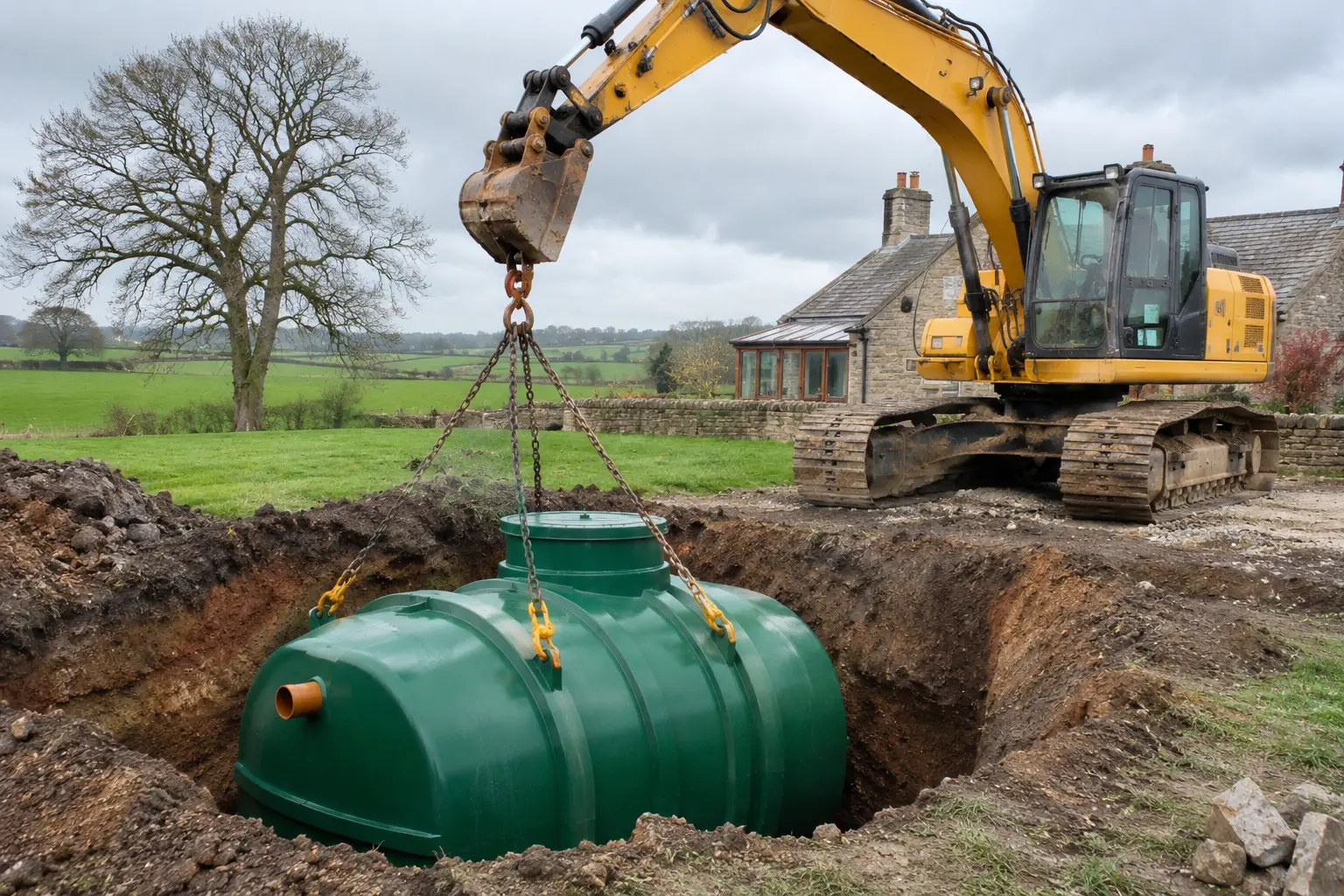
Klargester, Marsh, Tricel, Graf, WPL and Vortex sewage treatment plants, sized for your home and dug in with our own machines. The cleaner choice for off-mains homes, and the usual fix for a septic tank that runs into a ditch.
How a treatment plant works
1. Settle
Waste from the house flows into the first chamber. Solids sink to the bottom as sludge, like in a septic tank.
2. Treat
The liquid moves on to a chamber where air is added, so bacteria can grow and eat the pollution in it. This is the part a septic tank does not have.
3. Clean water out
A final chamber lets the last fine solids settle, and much cleaner water flows out to a drainage field or a stream.
Makes we install
We install all the main makes, and choose the plant to suit your house, your ground and where the water will go. Every new plant must meet the British Standard for small treatment plants, BS EN 12566.
Kingspan Klargester BioDisc
One of the best known plants in the UK. Slowly turning discs carry the bacteria in and out of the water. Sizes from a single house upwards.
Marsh Ensign
Marsh Industries' range of domestic treatment plants, made in the UK, for single houses and small groups of homes.
Tricel
Compact plants made in Ireland and widely fitted in the UK, for single houses and small groups of homes.
Graf
German made treatment plants, for single houses and larger properties.
WPL
The UK made WPL Diamond range of domestic treatment plants.
Vortex
Domestic treatment plants widely fitted across the UK.
Where the water goes
To a drainage field. Perforated pipes in stone trenches spread the water through the ground. Because the water is cleaner, the field can be smaller than for a septic tank. It needs a percolation test first.
To a ditch or stream. Allowed for a treatment plant, up to 5,000 litres a day, as long as the watercourse flows all year round. Not allowed for a septic tank.
Replacing an old septic tank?
If your septic tank runs into a ditch, a treatment plant is usually the simplest legal fix: the water can keep going to the same ditch, as long as it flows all year. We take out or fill in the old tank and put the new plant in its place or nearby.
How we install a treatment plant
- 1
Survey
We look at the house, the old system, where the water can go and how close the nearest watercourse and water supplies are.
- 2
Test and size
A percolation test if the water will go to the ground, and the plant sized for the house using British Water's Flows and Loads guidance.
- 3
Dig in
With our own machines. In wet or sandy ground the plant is set in concrete so it cannot float up when it is emptied.
- 4
Connect
Pipes from the house, the outlet to the drainage field or stream, and the electric supply to the plant.
- 5
Commission
Filled, switched on and checked, the old tank emptied and taken out or filled in, and the paperwork you need to keep.
What size treatment plant do you need?
Treatment plants are sold by how many people they serve, called the PE (population equivalent). A 6 PE plant is built for 6 people.
The size goes on bedrooms, not on who lives there now, because the next owners might fill every room. This uses the Environment Agency's own method.
Enter the houses and bedrooms and press Work it out.
How the sum works
From the Environment Agency's daily discharge calculator: 2 people for each house plus 1 for each bedroom, and never fewer than 5. Over 12 people it comes down by 10%, and over 25 people by 20%, because not everyone is in at once.
Each person is counted as 150 litres of waste water a day.
Under 2 m³ a day into the ground, or 5 m³ a day into a watercourse, you can usually go under the general binding rules without a permit.
Questions people ask
What is a sewage treatment plant?
A tank that treats the waste from your house, not just holds it. Air is pumped or mixed in so bacteria can break the waste down, and the water that comes out is much cleaner than from a septic tank. It is also called a package treatment plant.
Treatment plant or septic tank?
A treatment plant is the one to choose if the water has to go into a ditch or stream, because a septic tank is not allowed to. It also suits ground that drains too slowly for a full drainage field. A septic tank needs no power and costs less to run, but only works with a drainage field in ground that drains.
Can a treatment plant discharge into a ditch or stream?
Yes, within the general binding rules: no more than 5,000 litres a day, into a watercourse that flows all year, not one that dries up in summer. Near protected wildlife sites, or if you cannot meet the rules, you need a permit from the Environment Agency.
What size plant do I need?
Plants are sized by population equivalent (PE), roughly the number of people they serve, worked out from the number of bedrooms using British Water's Flows and Loads guidance. The rules require new plants to be sized this way. We size it for you.
Does a treatment plant need electricity?
Yes. Most run a small motor, pump or air blower all the time, so it needs a permanent supply. Running costs are usually modest, but it must never be switched off for long.
How often does it need servicing and emptying?
As the manufacturer says, and emptied at least once a year under the rules unless the maker says otherwise. Keep the records: buyers' solicitors ask for them when you sell.
Can I replace my septic tank with a treatment plant?
Yes, and it is the usual fix for a septic tank that discharges into a ditch. The old tank is emptied and taken out or filled in, and the new plant goes in, often in the same area.
Do I need permission?
A new treatment plant needs building regulations approval, and sometimes planning permission. It must meet the general binding rules, or you need an environmental permit.
What affects the cost?
The size and make of plant, how deep it has to go, whether it needs a drainage field or can go to a stream, the electric supply, access for machines, and taking out the old tank. We give you a written quote after the survey.
Also worth a look
Tell us about your property
Phone lines open Monday to Friday 8am to 5pm, Saturday 8am to 1pm. WhatsApp photos of the job any time, we reply in office hours.